Deploying Full Stack Apps
Mon Dec 29 2025
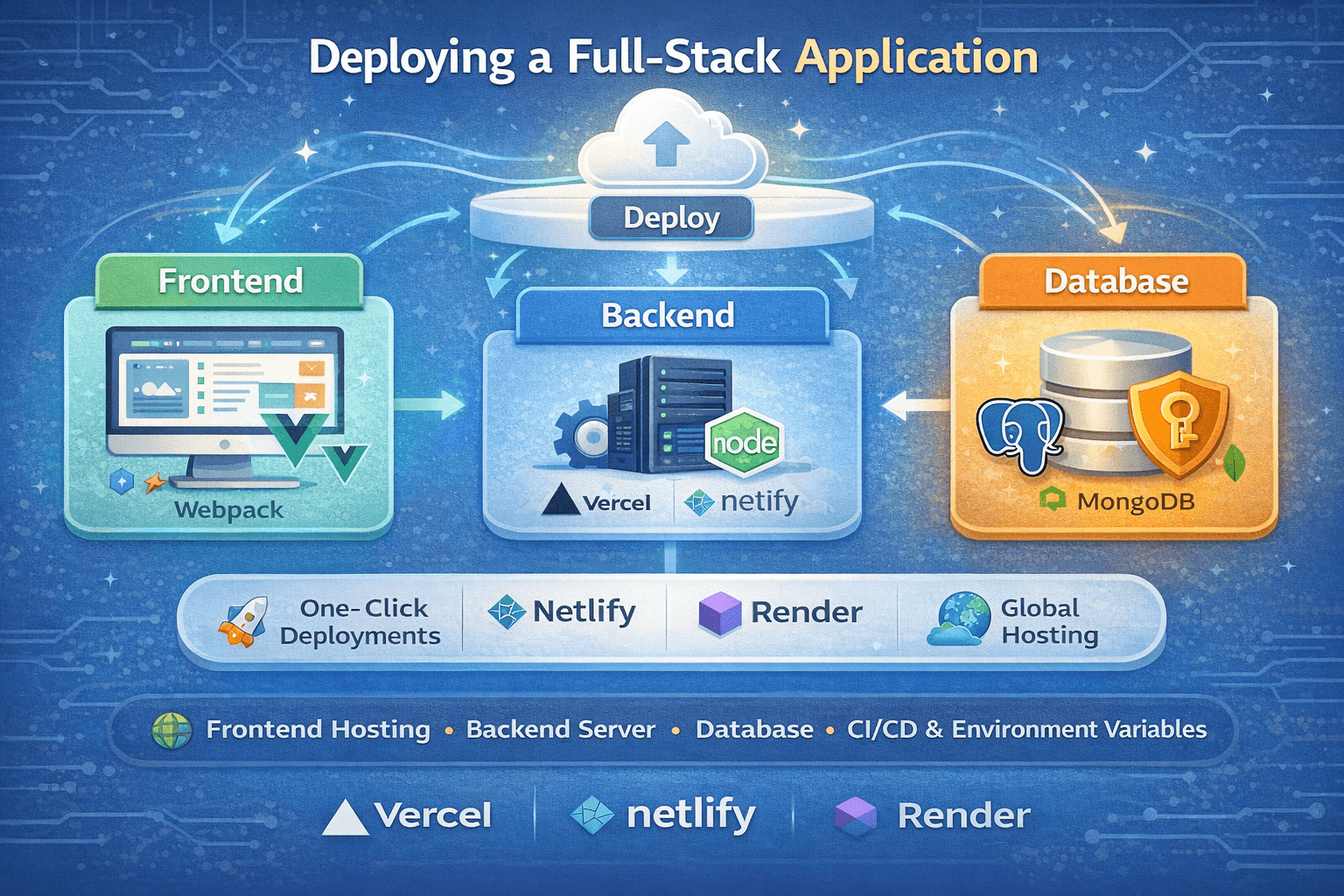
Deploying a Full-Stack Application
Deploying a full-stack application means taking both your frontend and backend and making them accessible to users over the internet. A typical full-stack deployment involves hosting the client-side application, running a backend server, and connecting everything to a database in a secure and scalable way.
Modern cloud platforms have greatly simplified this process, allowing developers to deploy applications quickly without managing complex infrastructure.
Key Components of a Full-Stack Deployment
A full-stack application usually consists of the following parts:
1. Frontend (Client-Side)
The frontend is responsible for the user interface and user experience. It is typically built using frameworks such as:
- React
- Vue
- Angular
Before deployment, the frontend is bundled and optimized into static assets (HTML, CSS, JavaScript) using tools like Webpack or Vite.
2. Backend (Server-Side)
The backend handles business logic, authentication, and communication with the database. Common backend technologies include:
- Node.js
- Express
- REST or GraphQL APIs
The backend runs on a server and listens for incoming HTTP requests from the frontend or other clients.
3. Database
The database stores application data such as users, products, or transactions. Depending on your use case, this could be:
- SQL databases (PostgreSQL, MySQL)
- NoSQL databases (MongoDB, Firebase)
Database connection credentials are usually stored securely using environment variables.
Deployment Workflow
A typical deployment flow looks like this:
- Build the frontend into production-ready static files
- Deploy the backend server to a hosting platform
- Configure environment variables (API keys, database URLs)
- Connect the frontend to the backend via API endpoints
- Set up a custom domain (optional)
Modern Deployment Platforms
Platforms like Vercel, Netlify, and Render have made full-stack deployment significantly easier by offering:
- 🚀 One-click deployments from Git repositories
- 🔁 Automatic CI/CD pipelines on every push
- 🔐 Secure environment variable management
- 🌍 Global CDN for frontend assets
- 📈 Easy scaling with minimal configuration
These platforms allow developers to focus more on building features and less on managing servers.
Environment Variables and Configuration
Sensitive information such as API keys and database credentials should never be hardcoded. Instead, deployment platforms provide environment variable management to:
- Keep secrets secure
- Separate development and production configurations
- Easily rotate credentials without redeploying code
Best Practices for Full-Stack Deployment
- Always use HTTPS
- Separate frontend and backend environments
- Use environment variables for secrets
- Enable logging and monitoring
- Automate deployments with CI/CD
- Test production builds before deploying
Conclusion
Deploying a full-stack application no longer requires deep infrastructure knowledge. With modern hosting platforms and automated deployment pipelines, developers can ship production-ready applications quickly, securely, and at scale. Understanding how frontend, backend, and database components work together during deployment is key to building reliable real-world applications.
← Back to Blogs